

Customer Feedback: Types, Methods, Examples and How to Use It Better
Customer feedback is information customers share about their experience with a company, product, service, support interaction, or brand.
It can be as simple as a star rating or as detailed as a customer interview. Complaints, survey answers, reviews, feature requests, support conversations, and written suggestions can all provide useful feedback.
The challenge is rarely collecting another comment. The harder part is deciding what the feedback means, whether it represents a wider pattern, what deserves action, and who should act on it.
A useful customer feedback process therefore connects four things:
- Listening to customers
- Organizing what they say
- Identifying patterns and priorities
- Acting on the findings and following up when appropriate
This guide explains how that process works, where customer feedback comes from, how businesses can use it, and the mistakes that make feedback programs less useful.
What Is Customer Feedback?
Customer feedback is information customers provide about their experiences, opinions, expectations, problems, preferences, or satisfaction with a business and what it offers.
That information may be intentionally requested by the company, or the customer may provide it without being asked.
Examples include:
- a customer satisfaction survey response
- an online product review
- a support complaint
- a feature request
- an NPS response
- a comment after a purchase
- feedback submitted through an app
- an email explaining a problem
- an interview response
- a social media comment
Customer feedback can describe what went well as easily as what went wrong.
A customer saying that onboarding was simple is feedback. So is a customer explaining that checkout was confusing.
Both can help a business understand the experience from the customer’s point of view.
Customer feedback is not the same as customer behavior
It is useful to distinguish feedback from behavioral data.
If analytics show that many users leave a checkout page before completing payment, that is behavioral evidence.
If customers say, “I left because my preferred payment method was unavailable,” that is feedback.
The two sources become more useful when they are considered together.
Behavior can show what happened. Customer feedback may help explain why it happened.
Some customer experience frameworks use the term “inferred feedback” for behavioral signals such as usage patterns. Others use customer feedback more narrowly for information customers actually express. For clarity, this guide mainly uses the second definition.
Why Is Customer Feedback Important?
Businesses make decisions about customers every day.
They change products, adjust pricing, redesign websites, modify support processes, create onboarding flows, and launch new features.
Without customer input, those decisions can rely too heavily on internal assumptions.
Feedback adds evidence from the people experiencing the product or service.
It helps uncover customer problems
Customers often encounter problems that are difficult to see from inside the business.
Examples might include:
- confusing instructions
- slow customer support
- an unclear checkout step
- difficult onboarding
- billing confusion
- missing product information
- delivery communication problems
- an important feature that is difficult to find
Repeated feedback about the same problem can signal that an issue deserves investigation.
It shows what customers value
Feedback is not only about complaints.
Positive comments can reveal what customers consider especially useful.
For example, customers may repeatedly praise:
- fast setup
- helpful support
- simple returns
- clear documentation
- reliability
- easy navigation
- a particular product feature
Those strengths may be worth protecting when the business makes future changes.
It adds context to customer experience metrics
A score alone can be difficult to interpret.
Suppose customer satisfaction falls from one survey period to another. The number indicates a change, but it does not automatically explain the cause.
Open-ended feedback may reveal that customers are frustrated by longer waiting times, a new interface, billing changes, or another specific problem.
The metric identifies the signal. Qualitative feedback can provide context.
It can guide product and service improvements
Customers can reveal unmet needs, recurring problems, and difficult parts of the experience.
That does not mean every customer request should become a feature.
Feedback should be considered alongside:
- how frequently the issue occurs
- which customers are affected
- business strategy
- technical feasibility
- cost
- expected customer impact
- other product and operational data
Customer feedback is evidence for decision-making, not an automatic instruction.
Types of Customer Feedback
There is no single universal classification system for customer feedback. A company may classify feedback according to how it was collected, what format it takes, when it was collected, or which part of the customer journey it relates to.

A practical overview looks like this:
| Dimension | Common categories | Example |
|---|---|---|
| Collection | Solicited or unsolicited | Survey vs unprompted review |
| Format | Quantitative or qualitative | Rating vs written comment |
| Structure | Structured or unstructured | Multiple-choice answer vs interview |
| Timing | Transactional or relationship | Support survey vs periodic survey |
| Sentiment | Positive, neutral, negative | Praise vs complaint |
| Subject | Product, support, billing, delivery, service | Feature request or service complaint |
The categories can overlap.
A customer might leave a negative, qualitative, unsolicited product review. A CSAT survey response might be positive, quantitative, structured, and transactional.
Solicited feedback
Solicited feedback is actively requested by the business.
Common examples include:
- customer surveys
- interviews
- feedback forms
- post-purchase questions
- cancellation surveys
- email feedback requests
- in-app prompts
Solicited feedback gives the business more control over the question, timing, and audience.
Unsolicited feedback
Unsolicited feedback is provided without a direct request.
Examples include:
- public reviews
- complaints
- social media posts
- customer emails
- community discussions
- spontaneous suggestions
This type of feedback can surface topics the company did not think to ask about.
Quantitative feedback
Quantitative feedback produces numerical information.
Examples include:
- satisfaction ratings
- NPS responses
- customer effort ratings
- star ratings
- yes/no responses
It is useful for tracking patterns and comparing results over time.
Qualitative feedback
Qualitative feedback is expressed through words rather than only numbers.
Examples include:
- open-ended survey responses
- interviews
- reviews
- support conversations
- complaint descriptions
- written suggestions
Qualitative feedback is often valuable because it provides context behind a score or action.
A dedicated analysis of the different customer feedback types can go deeper into these classifications and when each one is most useful.
Customer Feedback Examples
The following examples show how raw feedback can point to a more specific customer issue.
| Situation | Customer feedback | Possible insight |
|---|---|---|
| SaaS onboarding | “I connected my account but did not know what to do next.” | The next onboarding step may be unclear |
| Ecommerce checkout | “I expected Apple Pay and could not find it.” | Customers may want another payment option |
| Customer support | “The agent fixed the problem, but I waited too long.” | Resolution quality may be good while response time is poor |
| Product review | “The product works well, but the instructions were confusing.” | Documentation may need improvement |
| Cancellation | “We no longer need the features included in our plan.” | The plan may not match the customer’s current needs |
| Delivery | “My order arrived on time, but I did not receive tracking updates.” | Delivery communication may be the issue |
| Feature request | “Can I export this report as CSV?” | A customer workflow may require data export |
| Positive review | “I finished setup without contacting support.” | Ease of setup may be a product strength |
Notice the difference between general and specific feedback.
“Great product” is positive, but it gives the business limited information.
“Setup took five minutes and I did not need the help documentation” explains what the customer valued.
Specific feedback is generally easier to investigate and use.
How to Collect Customer Feedback
The best collection method depends on what you want to learn. A company investigating onboarding problems needs different feedback from a company measuring satisfaction after customer support.

Start with the question you need answered, then choose the collection method.
Customer surveys
Surveys are useful when you want consistent answers from multiple customers.
Common examples include:
- customer satisfaction surveys
- NPS surveys
- customer effort surveys
- post-purchase surveys
- onboarding surveys
- cancellation surveys
- customer service surveys
Surveys can contain quantitative questions, qualitative questions, or both.
A rating question may make responses easier to compare, while an optional open-ended question can explain the reason behind the rating.
Feedback forms
A feedback form provides customers with a place to submit comments, suggestions, or problems.
Forms may appear:
- on a website
- inside an application
- in a help center
- after completing a process
- on a dedicated feedback page
An always-available feedback form can capture comments that do not fit a scheduled survey.
Customer interviews
Interviews allow deeper discussion.
They can help researchers understand:
- motivations
- expectations
- workflows
- frustrations
- purchase decisions
- unmet needs
- language customers use to describe a problem
Interviews usually provide richer context than a short survey, although they require more time to conduct and analyze.
Customer support conversations
Support interactions contain feedback even when customers did not contact the business specifically to complete a survey.
Useful sources include:
- help desk tickets
- live chat
- phone calls
- customer emails
- escalation notes
Repeated support problems can reveal broader issues with a product, process, documentation, billing system, or service.
Online reviews
Public reviews can provide unsolicited customer feedback.
Customers may comment on:
- product quality
- reliability
- customer service
- delivery
- ease of use
- value
- returns
- overall experience
Reviews are especially useful when considered alongside private feedback channels because customers may communicate differently in public and private settings.
Social media and communities
Customers sometimes discuss a company without contacting it directly.
Feedback can appear in:
- social media posts
- online communities
- forums
- product communities
- industry discussion groups
These conversations may surface issues that formal surveys did not ask about.
In-product feedback
Digital products can collect feedback close to the experience being evaluated.
Examples include:
- rating a new feature
- reporting a bug
- submitting a feature request
- rating onboarding
- commenting after completing a task
Collecting feedback close to the experience can make it easier for the customer to remember what happened.
A Practical Customer Feedback Process
Collecting feedback is only one part of the process.
A simple customer feedback workflow can be organized into seven stages.
1. Decide what you need to learn
Start with a business or customer question.
For example:
- Why do customers abandon onboarding?
- Why are support satisfaction scores falling?
- What causes customers to cancel?
- Which product problems occur most often?
- Which parts of the purchase process create friction?
This prevents the business from collecting feedback simply because it feels like it should.
2. Choose the appropriate feedback method
Match the method to the question.
If you need a comparable satisfaction measure, a structured survey may make sense.
If you need to understand a complex customer workflow, interviews may provide better information.
If you want to find recurring service problems, support conversations may already contain useful evidence.
3. Collect feedback at the right point
Timing matters.
Examples include:
- post-purchase feedback after a purchase
- support feedback after a service interaction
- onboarding feedback after onboarding
- cancellation feedback when a customer leaves
- feature feedback after a customer uses the feature
The closer the request is to the relevant experience, the easier it may be for customers to recall details accurately.
4. Bring the feedback together
Feedback often becomes scattered across:
- survey platforms
- support tickets
- CRM records
- spreadsheets
- online reviews
- sales notes
- product boards
Businesses need a consistent way to bring useful feedback into a shared process.
That does not always require complex software. The important point is that relevant feedback should be findable and usable.
5. Categorize and analyze it
Create categories that reflect the issues customers actually discuss.
Possible categories include:
- usability
- bugs
- pricing
- support
- billing
- onboarding
- delivery
- feature requests
- documentation
- product quality
- complaints
- compliments
Then look for patterns.
Useful questions include:
- How frequently does the issue appear?
- Which customer groups mention it?
- Is the issue becoming more common?
- Where in the customer journey does it occur?
- Is it associated with a specific product or channel?
- How severe is its effect on the experience?
6. Prioritize and take action
Not every comment needs the same response.
A useful prioritization framework considers:
Frequency + customer impact + business relevance + strategic fit + feasibility
For example, a problem affecting checkout for many customers would normally deserve different attention from a highly specific feature request made by one user.
7. Close the feedback loop when appropriate
Closing the loop means communicating after feedback has been reviewed or acted on.
That might involve:
- telling a customer that a problem was fixed
- acknowledging a complaint
- announcing an improvement
- thanking customers for identifying an issue
- explaining that a requested change is not currently planned
The goal is not to send a personal reply to every anonymous survey response.
The goal is to avoid creating a feedback system where customers repeatedly share useful information but never see evidence that the business listens.
How to Analyze Customer Feedback
Good customer feedback analysis goes beyond separating comments into positive and negative groups.
The objective is to understand patterns, causes, affected customers, and potential actions.
Start with structured data
Quantitative data can help identify:
- score changes
- response distributions
- recurring low ratings
- trends over time
- differences between customer groups
This can tell you where to investigate.
Read the qualitative feedback
Written comments can explain the reasons behind the numbers.
Group similar comments into themes such as:
- speed
- price
- reliability
- support
- navigation
- onboarding
- usability
- product features
A low score and the comment explaining that score are usually more useful together than either one alone.
Segment feedback where useful
Overall averages can hide differences between customer groups.
Depending on the business, useful segments may include:
- new vs existing customers
- subscription plan
- product
- region
- device
- acquisition channel
- customer type
- support channel
For example, overall satisfaction may appear stable while mobile customers report a specific recurring problem.
Look for root causes
Customers often describe the symptom they experienced.
A customer might say:
“Support was terrible.”
That statement deserves attention, but it is not yet a diagnosis.
The underlying issue could be:
- a long waiting time
- multiple transfers
- unclear information
- repeated questions
- a product bug
- failure to resolve the issue
Understanding the cause helps the business choose a better response.
Customer Feedback Metrics
Customer feedback can also be measured through standardized customer experience metrics.
Three of the most common are CSAT, NPS, and CES.
Customer Satisfaction Score (CSAT)
CSAT measures how satisfied customers report being with an interaction, service, product, or experience.
It is commonly used after specific interactions such as:
- customer support
- purchases
- deliveries
- onboarding
The exact scale can vary depending on the survey design.
Net Promoter Score (NPS)
NPS uses a likelihood-to-recommend question and classifies respondents according to the established Net Promoter Score methodology.
Businesses often use it as a broader relationship or loyalty measure rather than a score for one narrow interaction.
Customer Effort Score (CES)
Customer Effort Score measures how easy or difficult customers perceive a task or interaction to be.
It may be used after experiences such as:
- resolving a support issue
- making a purchase
- completing onboarding
- returning an item
- finding information
These metrics answer different questions.
A company should choose the metric that matches what it actually wants to understand instead of using one score for every part of the customer journey.
What Is a Customer Feedback Loop?
A customer feedback loop is the recurring process of collecting customer input, understanding it, taking action, and communicating back when appropriate.
A simple feedback loop can be represented as:
Collect → Organize → Analyze → Prioritize → Act → Follow up → Measure again
The final stage matters.
After a change is made, new feedback can help determine whether the customer experience actually improved.
For example:
- Customers repeatedly say checkout is confusing.
- The team identifies the step causing difficulty.
- The checkout flow is redesigned.
- Customers are informed where appropriate.
- New feedback and behavior are monitored.
- The team checks whether the problem has decreased.
This turns customer feedback into an ongoing learning system instead of a one-time survey exercise.
How to Turn Customer Feedback Into Action
Feedback becomes more valuable when teams know how to decide what deserves attention.
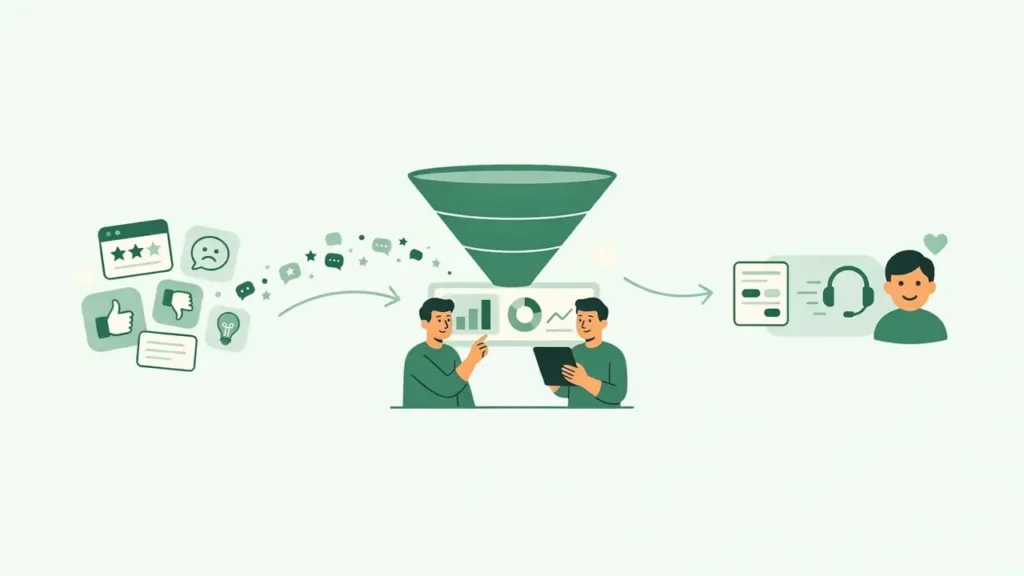
Look at frequency
How often does the issue appear?
A recurring problem across many customers generally deserves more investigation than an isolated preference.
Consider severity
Frequency is not the only factor.
A rare issue that prevents payment, causes data loss, creates a serious service failure, or blocks access may still deserve urgent attention.
Identify who is affected
Consider whether the problem affects:
- new customers
- long-term customers
- high-value accounts
- one product
- one country
- mobile users
- a specific customer segment
Context changes the meaning of the feedback.
Connect feedback with other evidence
Feedback becomes stronger when it can be considered alongside:
- product analytics
- support data
- cancellation reasons
- transaction data
- retention data
- customer journey information
Customer comments provide the customer’s perspective. Other evidence can help establish scale and context.
Assign ownership
Useful feedback can still disappear if nobody owns the next step.
For prioritized issues, define:
- who is responsible
- what action should be evaluated
- what evidence is needed
- when the issue will be reviewed
- how success will be measured
Customer Feedback Best Practices
Ask specific questions
Specific questions tend to produce more actionable responses.
Instead of:
What do you think about our company?
A business might ask:
How easy was it to complete your return today?
The second question connects directly to an experience that can be evaluated.
Match the question to the customer journey
Ask about an experience when the experience is relevant.
Examples include:
- delivery feedback after delivery
- support feedback after resolution
- checkout feedback after purchase
- onboarding feedback after onboarding
- cancellation feedback during cancellation
Keep surveys focused
Every survey question should have a purpose.
Before adding a question, determine what decision the answer could influence.
Questions that do not support a clear objective may add effort without adding useful information.
Combine ratings with context
A score provides structure.
An open-ended follow-up can explain the score.
For example:
How satisfied were you with the support you received?
followed by:
What is the main reason for your rating?
The combination can be more useful than either response on its own.
Use more than one feedback channel
Survey responses are only one source of customer input.
Reviews, interviews, customer service interactions, product feedback, and other channels may reveal different parts of the experience.
Separate recurring patterns from isolated requests
Individual comments can contain valuable insight, but one comment should not automatically determine a business decision.
Look for recurring problems, then use individual responses to understand them in more detail.
Protect customer privacy
Only collect information you genuinely need.
When surveys or feedback forms involve personal information, businesses should clearly explain how information is handled and follow applicable privacy and data protection requirements.
Respond when follow-up is useful
Some situations deserve direct follow-up, particularly:
- unresolved complaints
- major service failures
- serious account issues
- feedback that requires clarification
- important customer relationships
Anonymous surveys, on the other hand, may not allow or require individual responses.
Common Customer Feedback Mistakes
Collecting feedback without a purpose
A long survey is not useful simply because it produces more data.
Decide what you need to learn before deciding what to ask.
Treating surveys as the entire feedback program
Surveys are useful, but customers also communicate through reviews, support interactions, direct conversations, communities, and product behavior.
A wider listening system can provide a more complete view.
Following the loudest request
The most persistent customer is not necessarily representative of the largest customer problem.
Consider frequency, severity, customer segment, evidence, and strategic relevance.
Looking only at complaints
Positive feedback also contains useful information.
It can identify strengths that customers value and that a business should avoid accidentally damaging during future changes.
Ignoring neutral responses
Customers who are neither highly positive nor openly dissatisfied can still identify friction.
Neutral feedback may reveal issues that have not yet become serious complaints.
Collecting feedback but never acting
Feedback that stays inside dashboards, spreadsheets, or presentation slides creates little customer value.
The process needs ownership and a route from insight to decision.
Asking customers for the same information repeatedly
If a company already has relevant feedback, asking customers to repeat it can add unnecessary effort.
Centralizing feedback helps teams learn from existing information before requesting more.
Customer Feedback vs Reviews, Customer Satisfaction and Customer Insights
These concepts are related but not identical.
| Term | What it means |
|---|---|
| Customer feedback | Information customers provide about their experience |
| Customer review | A public or semi-public evaluation of a product, service, or business |
| Customer satisfaction | The customer’s reported level of satisfaction with an experience |
| Customer insights | Conclusions developed from feedback, research, behavior, analytics, and other customer evidence |
| Voice of the Customer | A broader process for capturing and understanding customer needs, expectations, and experiences |
A customer review is therefore one source of customer feedback.
Customer feedback can contribute to customer insights, but the raw comment itself is not always an insight.
For example:
Feedback: “I could not find the export button.”
Pattern: Similar comments appear across multiple new users.
Insight: New users may not discover an important reporting function because of its placement or labeling.
That distinction matters because collecting customer comments and understanding customers are not exactly the same task.
Frequently Asked Questions
What is customer feedback in simple terms?
Customer feedback is information customers share about their experience with a company, product, service, or interaction. It can include survey answers, ratings, reviews, complaints, suggestions, support conversations, and feature requests.
What are examples of customer feedback?
Examples include a product review, NPS response, satisfaction rating, complaint, support message, feature request, post-purchase survey answer, interview response, social media comment, or written suggestion.
What are the main types of customer feedback?
Customer feedback can be classified in several ways. Common categories include solicited and unsolicited feedback, quantitative and qualitative feedback, structured and unstructured feedback, and transactional and relationship feedback.
How do you collect customer feedback?
Common methods include surveys, feedback forms, interviews, customer support conversations, online reviews, email requests, social media, community monitoring, and in-product prompts.
Why is customer feedback important?
It helps businesses understand customer problems, identify strengths, add context to CX metrics, test internal assumptions, and find opportunities to improve products, services, and customer-facing processes.
What is a customer feedback process?
A customer feedback process usually includes defining what you want to learn, collecting relevant feedback, centralizing it, categorizing and analyzing responses, prioritizing issues, taking action, and following up when appropriate.
What is a customer feedback loop?
A customer feedback loop is the recurring process of collecting feedback, analyzing it, acting on useful findings, communicating back where appropriate, and measuring the experience again.
Is customer feedback qualitative or quantitative?
It can be either. Ratings, scores, and structured responses are quantitative. Written comments, reviews, interviews, complaints, and open-ended survey answers are qualitative.
What is the difference between customer feedback and customer satisfaction?
Customer feedback is the broader information customers provide about their experience. Customer satisfaction is one aspect of the experience and can be measured through feedback such as a CSAT survey.
How should businesses prioritize customer feedback?
Consider how frequently the issue occurs, its severity, the customers affected, business relevance, strategic fit, supporting evidence, and the feasibility of taking action.
Should every customer suggestion be implemented?
No. A suggestion may identify an important customer need without identifying the best solution. Businesses should evaluate requests alongside wider patterns, customer impact, strategy, technical considerations, cost, and other evidence.
How often should customer feedback be collected?
There is no universal schedule. Transactional feedback is usually tied to specific experiences, while broader relationship feedback may be collected periodically. The timing should match the question the business is trying to answer.
The Practical Takeaway
Customer feedback is most useful when it becomes part of a repeatable decision-making process. Do not stop at collecting ratings and comments.
Define what you want to understand, listen at relevant customer touchpoints, organize the responses, identify patterns, compare feedback with other evidence, prioritize the issues that matter, and assign ownership for action.
The goal is not to collect the largest possible amount of feedback.
The goal is to learn something useful from customers and use that evidence to make better decisions.