
What Are Customer Insights? Definition, Types & Examples
What Are Customer Insights? Definition, Types, Examples & How to Use Them
Customer insights are the useful conclusions a business draws from customer data, feedback, behavior, and research. They help explain what customers need, what influences their decisions, where they experience problems, and what a business can do differently.
A customer insight is more than a data point. A metric might show that customers are abandoning a checkout page, for example. An insight goes further by identifying a likely reason behind that behavior and connecting it to a potential action.
This guide explains what customer insights are, how they differ from customer data, feedback, analytics, and market research, where they come from, and how businesses can turn them into practical decisions.
What Are Customer Insights?
A customer insight is an evidence-based understanding of customer behavior, needs, preferences, motivations, or experiences that can inform a business decision.
Customer insights can come from many forms of evidence, including:
- Customer feedback
- Surveys
- Interviews
- Reviews
- Purchase data
- CRM records
- Website behavior
- Product usage
- Customer support conversations
- Customer experience metrics
- Market research
The important part is the interpretation.
For example, suppose a SaaS company notices that many new customers stop using its product shortly after completing setup.
The usage data tells the company what is happening.
After combining that data with onboarding feedback and support conversations, the company may discover that customers are struggling to understand how to configure an important feature.
That understanding is the customer insight.
The company can then use the insight to improve onboarding, documentation, or product guidance.
In simple terms:
Customer data provides evidence. Customer insights provide understanding. Business actions use that understanding to make decisions.
TechTarget similarly defines customer insight around interpreting customer data, behavior, and feedback into conclusions that can guide actions.
Customer Data vs. Customer Insights
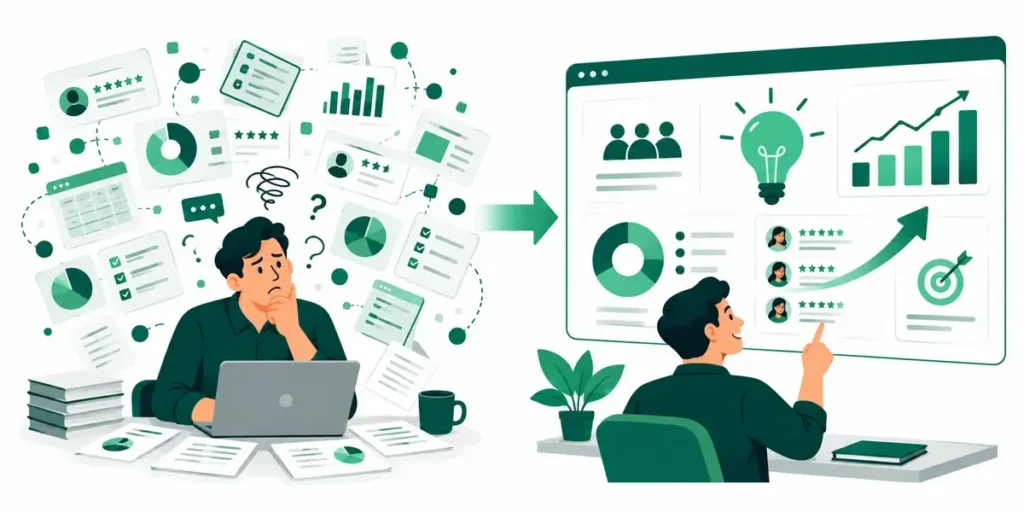
Customer data and customer insights are closely related, but they are not the same thing.
| Customer data | Customer insights |
|---|---|
| Raw evidence about customers | Interpretation of customer evidence |
| Shows events, behaviors, responses, or characteristics | Helps explain what those patterns may mean |
| Can be quantitative or qualitative | Requires analysis and interpretation |
| Often describes what happened | Can help explain why something happened |
| Provides inputs for analysis | Helps inform decisions and actions |
Consider this example:
Customer data:
40% of surveyed customers say onboarding is difficult.
Observation:
A substantial portion of respondents report onboarding problems.
Customer insight:
Customers may be struggling because important setup instructions are difficult to find during the early stages of onboarding.
Action:
Improve the onboarding flow and make essential setup guidance easier to access.
The distinction matters because collecting more data does not automatically create better understanding. The value comes from finding meaningful patterns and connecting them to a business question.
How Customer Data Becomes a Customer Insight
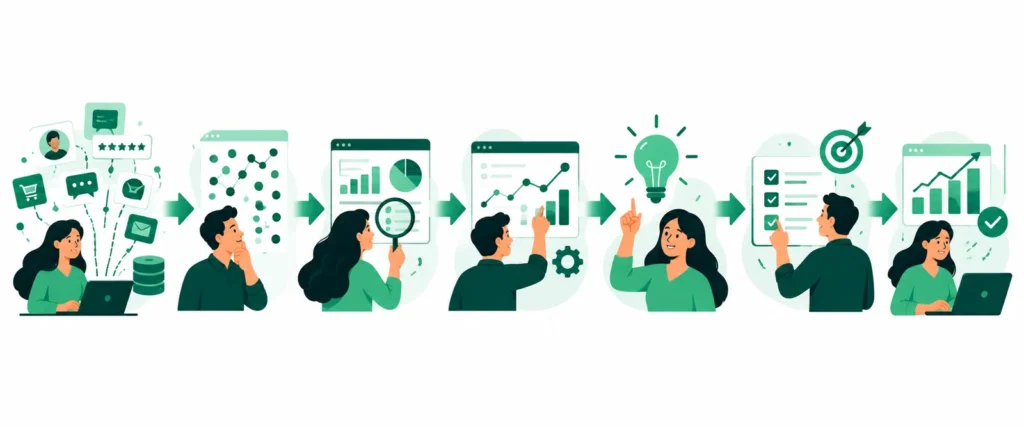
A practical customer insight process can be viewed as a sequence:
Data → Pattern → Interpretation → Insight → Action → Measurement
1. Start with a business question
Begin with something you need to understand.
For example:
Why are customers cancelling within their first few months?
A clear question helps determine which data matters.
2. Collect relevant customer data
Gather evidence that can help answer the question.
Depending on the problem, this might include:
- Product usage
- Customer interviews
- Cancellation surveys
- Support conversations
- Account information
- Purchase history
- Customer satisfaction scores
3. Identify patterns
Look for recurring behaviors, differences between customer groups, changes over time, or unusual results.
For example, customers who cancel may consistently have lower product usage before cancellation.
4. Interpret the pattern
A pattern is not automatically an explanation.
Ask what could reasonably account for the behavior and what additional evidence is needed to support that interpretation.
5. Validate the insight
Compare the finding with other evidence.
If usage data suggests customers are struggling with a feature, customer interviews or support conversations can help determine whether that interpretation makes sense.
6. Turn the insight into an action
An insight becomes more useful when it informs a specific decision.
The action could involve changing:
- A product feature
- An onboarding process
- Customer communication
- Pricing or packaging
- Marketing messages
- Support processes
7. Measure what happens next
After acting on an insight, monitor an appropriate outcome.
This closes the loop between customer evidence, decision-making, and results.
IBM describes customer analytics through a similar identification, collection, organization, analysis, and action process.
What Makes a Good Customer Insight?
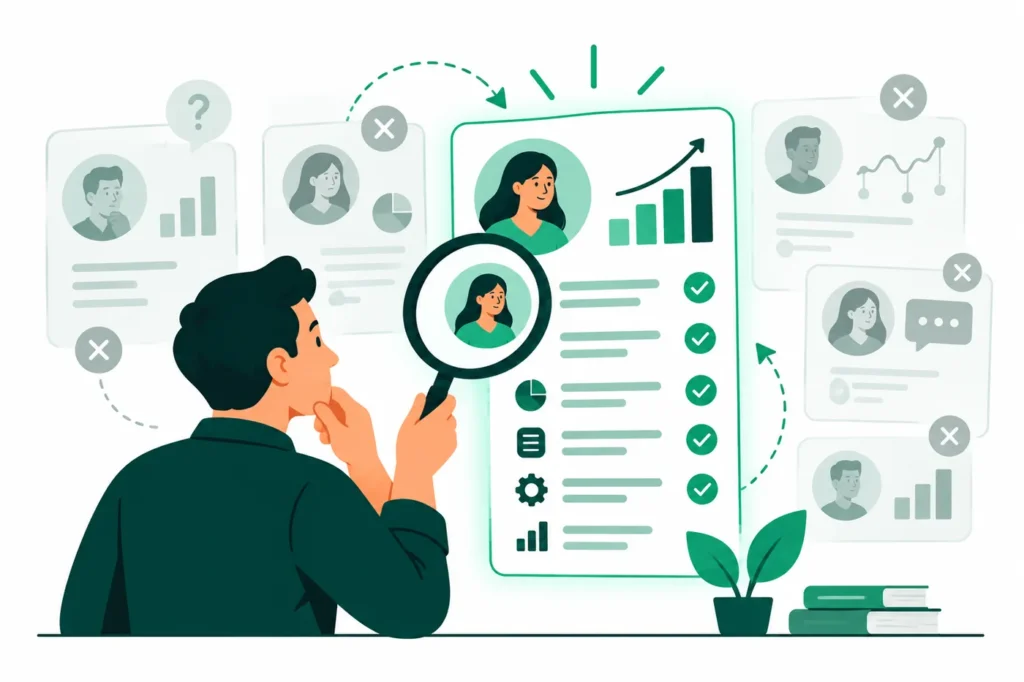
Not every observation deserves to be called an insight.
A useful customer insight should generally have several characteristics.
Evidence-based
It should be grounded in actual customer evidence rather than assumptions about what customers want.
Specific
“Customers do not like our product” is too broad to guide a decision.
A more useful finding identifies a particular behavior, need, segment, or experience.
Relevant
The insight should relate to a meaningful customer or business question.
Meaningful
It should reveal something that improves understanding of customer behavior, needs, or experiences.
Actionable
A useful insight should help a team determine what to investigate, change, test, or prioritize.
Measurable
Where possible, the resulting action should have an outcome that can be monitored.
Qualtrics identifies characteristics such as specificity, actionability, relevance, and timeliness when describing strong consumer insights.
Types of Customer Insights
Customer insights can be classified in several ways. The right classification depends on the questions a business is trying to answer.
Behavioral insights
Behavioral insights focus on what customers actually do.
Examples include:
- How customers use a product
- Which pages they visit
- What features they use
- How often they purchase
- Where they abandon a process
Behavioral data can reveal patterns that customers may not explicitly describe in surveys or interviews.
Demographic insights
Demographic insights describe characteristics such as:
- Age
- Location
- Occupation
- Income
- Education
- Household characteristics
Businesses can use these characteristics to understand differences between customer groups.
Psychographic insights
Psychographic insights relate to factors such as:
- Values
- Attitudes
- Interests
- Preferences
- Motivations
- Lifestyle
These insights can help explain why customers respond differently to products, messages, or experiences.
Customer feedback insights
These insights come from what customers explicitly tell a business.
Sources include:
- Surveys
- Interviews
- Reviews
- Support conversations
- Feedback forms
- Customer communities
Feedback can be especially useful for understanding opinions, frustrations, expectations, and perceived problems.
Product insights
Product insights help teams understand how customers interact with a product and where improvements may be needed.
They can involve:
- Feature usage
- Product adoption
- Usability problems
- Feature requests
- Product satisfaction
- Areas of friction
Customer journey insights
Customer journey insights focus on experiences across different stages of the relationship.
For example:
Discovery → Evaluation → Purchase → Onboarding → Usage → Support → Renewal
A journey perspective can help identify where customers experience unnecessary friction.
Purchasing insights
Purchasing insights help explain buying behavior.
They can address questions such as:
- What influences a purchase?
- Which products are purchased together?
- What prevents customers from buying?
- What encourages repeat purchases?
- Which customer groups have different purchasing patterns?
Customer experience insights
Customer experience insights focus specifically on interactions between customers and a business.
These may include:
- Website experiences
- Sales interactions
- Product experiences
- Customer support
- Onboarding
- Billing
- Renewal
Qualtrics distinguishes broader consumer insights from customer experience insights by focusing CX insights specifically on interactions and touchpoints throughout the customer journey.
Retention and churn insights
These insights help businesses understand why customers stay, become inactive, or leave.
For example, a business may discover that customers who fail to reach a particular activation milestone during onboarding are more likely to cancel later.
That finding can guide customer success and retention work.
Predictive customer insights
Predictive insights use historical and current data to estimate possible future behaviors or outcomes.
Examples can include:
- Customers who may be at risk of churn
- Likely purchasing behavior
- Potentially valuable customer segments
- Expected demand patterns
Predictive analytics uses historical and current data to estimate future customer behavior.
Where Do Customer Insights Come From?
Customer insights rarely come from a single source.
Combining multiple sources can provide a more complete view of customer behavior and experience.
Customer surveys
Surveys can collect structured feedback about:
- Satisfaction
- Preferences
- Expectations
- Experiences
- Product needs
Metrics such as NPS, CSAT, and CES can also provide structured customer experience data.
Customer interviews
Interviews allow businesses to explore customer motivations, frustrations, expectations, and experiences in more depth.
Customer reviews
Reviews can reveal recurring complaints, positive experiences, product preferences, and expectations.
Customer support conversations
Support interactions can expose recurring problems that customers may not report through formal surveys.
For example, repeated questions about the same feature may indicate that the product or documentation needs improvement.
CRM data
CRM systems can contain information about:
- Customer interactions
- Sales activity
- Account characteristics
- Purchase history
- Customer relationships
Website analytics
Website behavior can help reveal:
- Popular pages
- Drop-off points
- Conversion behavior
- Navigation patterns
- Content engagement
Product analytics
For digital products, usage data can show:
- Feature adoption
- Activation
- Engagement
- Drop-off
- Usage frequency
Purchase and transaction data
Transaction records can help identify:
- Purchase frequency
- Average order behavior
- Repeat purchases
- Product combinations
- Customer value
Social media and online communities
Public conversations can provide additional evidence about customer opinions, questions, frustrations, and preferences.
IBM identifies sources such as geographic, transactional, feedback, customer support, survey, social media, website, email, and CRM data as useful inputs to customer analytics.
Customer Insights vs. Customer Feedback

Customer feedback is information customers provide directly or indirectly.
A customer insight is the understanding that emerges when evidence is interpreted in context.
For example:
Customer feedback:
“The reporting dashboard is difficult to use.”
Customer insight:
Customers may be struggling because important reporting functions are difficult to find or understand.
Potential action:
Review the dashboard navigation and test whether users can complete common reporting tasks more easily.
The two concepts therefore work together.
Feedback is a source of evidence. Insight is an interpretation of evidence.
Maze makes a similar distinction, describing customer feedback as communication from customers and customer insights as information extracted from feedback to support better decisions.
Customer Insights vs. Customer Analytics
Customer analytics is the process of using customer data to analyze behavior and inform decisions.
Customer insights are the meaningful conclusions that can emerge from that analysis.
For example:
Analytics:
Customers from one segment have lower product usage.
Insight:
That segment may be encountering a particular adoption barrier.
Action:
Investigate the barrier and test an improvement.
IBM defines customer analytics as the use of customer data to track, analyze, and make informed decisions about customer needs and expectations.
So the terms are closely connected, but they are not interchangeable.
Customer analytics is a method of analysis. Customer insights are an important output of that analysis.
Customer Insights vs. Consumer Insights
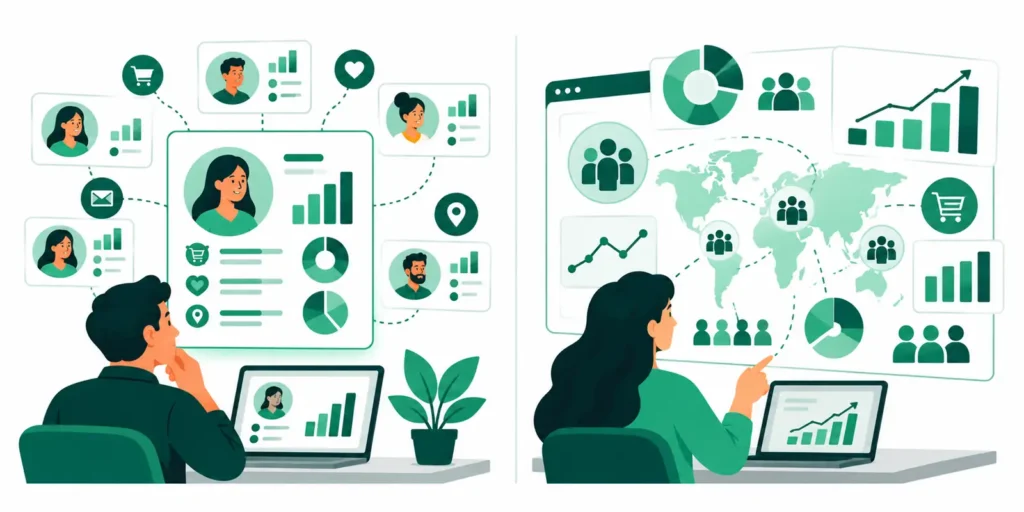
The terms customer insights and consumer insights overlap, and different organizations may use them differently.
A practical distinction is that customer insights usually focus on people who interact with or purchase from a business, while consumer insights can refer more broadly to understanding people, behaviors, preferences, and needs within a target market.
Maze describes customer insights as typically relating to existing customers, while consumer insights can refer to a broader market.
Qualtrics similarly describes consumer insights as information about behaviors, wants, needs, and demographic characteristics of a target audience.
The exact terminology is less important than defining the population being studied.
Customer Insights vs. Market Research
Market research and customer insights are related, but they are not identical.
| Market research | Customer insights |
|---|---|
| Studies a market, audience, competitors, or broader environment | Focuses on understanding customer needs, behavior, experiences, or motivations |
| Can include primary and secondary research | Can combine many sources of customer evidence |
| Often answers market-level questions | Often answers customer-level questions |
| Produces research findings | Produces interpretations that can inform decisions |
Market research can therefore be one source of customer insights, rather than a synonym for customer insights.
Shopify explicitly describes market research as one way of gathering information that can contribute to customer insights.
Customer Insight Examples
The easiest way to understand customer insights is to see how a signal can become an interpretation and then an action.
| Customer signal | Potential insight | Possible action |
|---|---|---|
| Customers repeatedly ask about integrations | Integrations may influence how some customers evaluate the product | Make integration information easier to find and investigate demand |
| New customers frequently stop during onboarding | A stage of onboarding may be creating friction | Examine that stage and test a simpler flow |
| Support questions increase after a feature release | Customers may be having difficulty understanding or using the feature | Review the feature experience and supporting documentation |
| Cancellation feedback repeatedly mentions a missing capability | The capability may matter to retention for a particular segment | Investigate the affected segment and assess the product gap |
| One product feature receives consistently high usage | The feature may be especially important to customer value | Investigate what makes it valuable and consider further improvements |
| Customers repeatedly praise a specific part of the experience | That element may contribute to customer satisfaction or loyalty | Identify whether the experience can be replicated elsewhere |
These examples illustrate an important principle:
A customer insight should connect evidence to understanding.
The action should then be based on the strength of that evidence rather than an assumption.
How Businesses Use Customer Insights
Customer insights can support decisions across multiple teams.
Product development
Product teams can use customer insights to understand:
- Feature needs
- Product friction
- Adoption barriers
- Usage patterns
- Customer priorities
Marketing
Marketing teams can use insights to understand:
- Customer motivations
- Messaging preferences
- Audience segments
- Purchase drivers
- Customer pain points
Sales
Sales teams can use customer insights to understand:
- Buying criteria
- Common objections
- Customer priorities
- Reasons customers choose one solution over another
Customer Success
Customer success teams can use insights to improve:
- Onboarding
- Product adoption
- Customer health
- Retention
- Churn prevention
Customer Support
Support teams can identify recurring issues and determine which problems may need changes to the product, documentation, or service process.
Customer Experience
CX teams can combine feedback, behavioral data, and experience metrics to identify friction across the customer journey.
Business strategy
Leadership teams can use customer evidence to evaluate product priorities, customer segments, market opportunities, and areas requiring improvement.
How to Gather Customer Insights
A practical approach is to combine qualitative and quantitative evidence.
1. Define what you want to learn
Start with a specific question.
For example:
Why are customers not completing onboarding?
2. Identify the relevant customer group
Different customer segments can have very different needs and behaviors.
Consider factors such as:
- Customer type
- Product usage
- Customer lifecycle stage
- Industry
- Purchase behavior
- Account value
3. Combine quantitative and qualitative data
Quantitative data can reveal patterns and scale.
Qualitative information can provide context around customer motivations and experiences.
Maze describes quantitative analysis as particularly useful for understanding “what” is happening, while qualitative analysis can help explore “why.”
4. Look for recurring patterns
Do not rely automatically on a single response.
Look for patterns across:
- Customers
- Segments
- Time periods
- Channels
- Behaviors
5. Compare different evidence sources
If behavioral data and customer feedback point toward the same problem, confidence in the finding can increase.
If they disagree, investigate the difference rather than forcing a conclusion.
6. Turn the finding into a decision
Ask:
What should we change, investigate, test, or prioritize based on this finding?
7. Measure the outcome
After taking action, monitor the relevant customer or business metric.
This makes the customer insight process continuous rather than a one-time research exercise.
Customer Insights and AI
AI can help businesses analyze customer information at a larger scale.
Potential applications include:
- Text analysis
- Sentiment analysis
- Feedback categorization
- Pattern detection
- Customer segmentation
- Predictive analysis
- Real-time analysis
AI systems can process both structured data, such as transactions and website analytics, and unstructured information, such as reviews and support conversations. Shopify describes these applications in its current guide to AI customer insights.
However, AI analysis does not eliminate the need for human judgment.
Someone still needs to determine:
- Whether the data is relevant
- Whether a pattern is meaningful
- Whether the interpretation makes sense
- Whether additional evidence is required
- What action is appropriate
IBM similarly describes modern customer analytics as combining AI and human actions during analysis and decision-making.
Customer Insights Tools
Businesses use different types of software to collect and analyze customer information.
Common categories include:
- Survey tools
- Customer feedback platforms
- CRM systems
- Product analytics
- Customer service platforms
- User research tools
- Text and sentiment analysis
- Customer data platforms
The right tool depends on the question being investigated and the data sources available.
For example, a business trying to understand product adoption may need product analytics, while a team investigating customer satisfaction may need survey and feedback data.
Tools can make data collection and analysis easier, but software alone does not guarantee useful insights.
Common Customer Insight Mistakes
Treating data as an insight
A number or customer comment is evidence. It may require further analysis before it becomes a meaningful insight.
Relying on one data source
Surveys, analytics, reviews, support conversations, and transaction data each reveal different parts of the customer experience.
Overreacting to individual feedback
One customer’s experience can be important, but it does not automatically represent the entire customer base.
Ignoring customer segments
An average result can hide important differences between customer groups.
Confusing correlation with causation
Two things happening together does not automatically mean one caused the other.
Collecting feedback without acting on it
Customer research creates limited value if organizations repeatedly collect feedback but never use the findings.
Using outdated information
Customer needs and behaviors can change. Important insights should be reviewed as the underlying customer context changes.
Focusing only on metrics
Metrics can show that something changed. Additional research may be needed to understand why.
Frequently Asked Questions About Customer Insights
What is a customer insight?
A customer insight is an evidence-based understanding of customer behavior, needs, preferences, motivations, or experiences that can inform a business decision.
What is an example of a customer insight?
If product usage data shows that customers frequently stop using a feature and support conversations reveal that the feature is difficult to understand, the combined evidence may indicate an adoption problem that needs to be investigated and addressed.
What is the difference between customer data and customer insights?
Customer data is evidence about customers. Customer insights are meaningful interpretations of that evidence that help a business understand customers and make decisions.
What are the main types of customer insights?
Common types include behavioral, demographic, psychographic, feedback, product, customer journey, purchasing, customer experience, retention, churn, and predictive insights.
How do you gather customer insights?
You can gather customer insights from surveys, interviews, reviews, support conversations, CRM records, website and product analytics, transaction data, customer research, and other customer touchpoints.
Why are customer insights important?
Customer insights help businesses understand customer needs and behavior so teams can make more informed decisions about products, marketing, sales, customer experience, support, and retention.
What is the difference between customer insights and customer feedback?
Customer feedback is information provided by customers. Customer insights are the meaningful conclusions a business derives from feedback and other evidence.
What is the difference between customer insights and consumer insights?
Customer insights generally focus on understanding customers, while consumer insights can refer more broadly to behaviors, needs, preferences, and characteristics across a target audience or market. Terminology varies between organizations.
What is the difference between customer insights and customer analytics?
Customer analytics is the process of analyzing customer data. Customer insights are meaningful conclusions that can emerge from that analysis.
What tools are used for customer insights?
Businesses use survey platforms, feedback systems, CRM software, product analytics, customer service platforms, research tools, text analysis systems, and customer data platforms.
How can AI be used for customer insights?
AI can help analyze large volumes of structured and unstructured customer data, identify patterns, categorize feedback, analyze text, segment customers, and support predictive analysis.
How do you turn customer data into actionable insights?
Start with a specific business question, collect relevant data, identify patterns, interpret the evidence, validate important findings, decide on an action, and measure the result.
Final Takeaway
Customer insights are not simply customer data.
Data gives you evidence about what customers do, say, buy, or experience. Analysis helps identify patterns. Customer insights provide a meaningful interpretation of those patterns, and actions turn that understanding into business decisions.
A useful way to remember the process is:
Customer data → Pattern → Interpretation → Insight → Action → Measurement
The strongest customer insight programs do not simply collect more information. They focus on asking better questions, combining relevant evidence, understanding the customer context, and turning what they learn into decisions.